
BLOG ·
What Does EnrouteAI Do?
The shortest true answer: EnrouteAI helps truckload carriers price shipper RFPs. This page is the longer answer, stage by stage, plus what EnrouteAI deliberately is not.
EnrouteAI is RFP pricing software for truckload carriers. A pricing team drops in the bid file a shipper sent, exactly as it arrived, and works through a priced bid: every lane rated from the carrier's own strategy, costs, and history, a market band beside each rate for the sanity check, the shipper's fuel program applied correctly, and the finished bid written back into the shipper's original format, ready to submit. It replaces the spreadsheet grind between "the RFP landed" and "the bid went out," and nothing else about how a carrier runs.
Who it is for
Pricing and sales teams at asset-based truckload carriers with contract freight: the one to five people who own the rates, usually working RFPs between everything else they own, usually with a DAT or SONAR subscription that shows the market but not their price. If bids arrive faster than they can be priced properly, that is the user.
What happens to a bid inside EnrouteAI
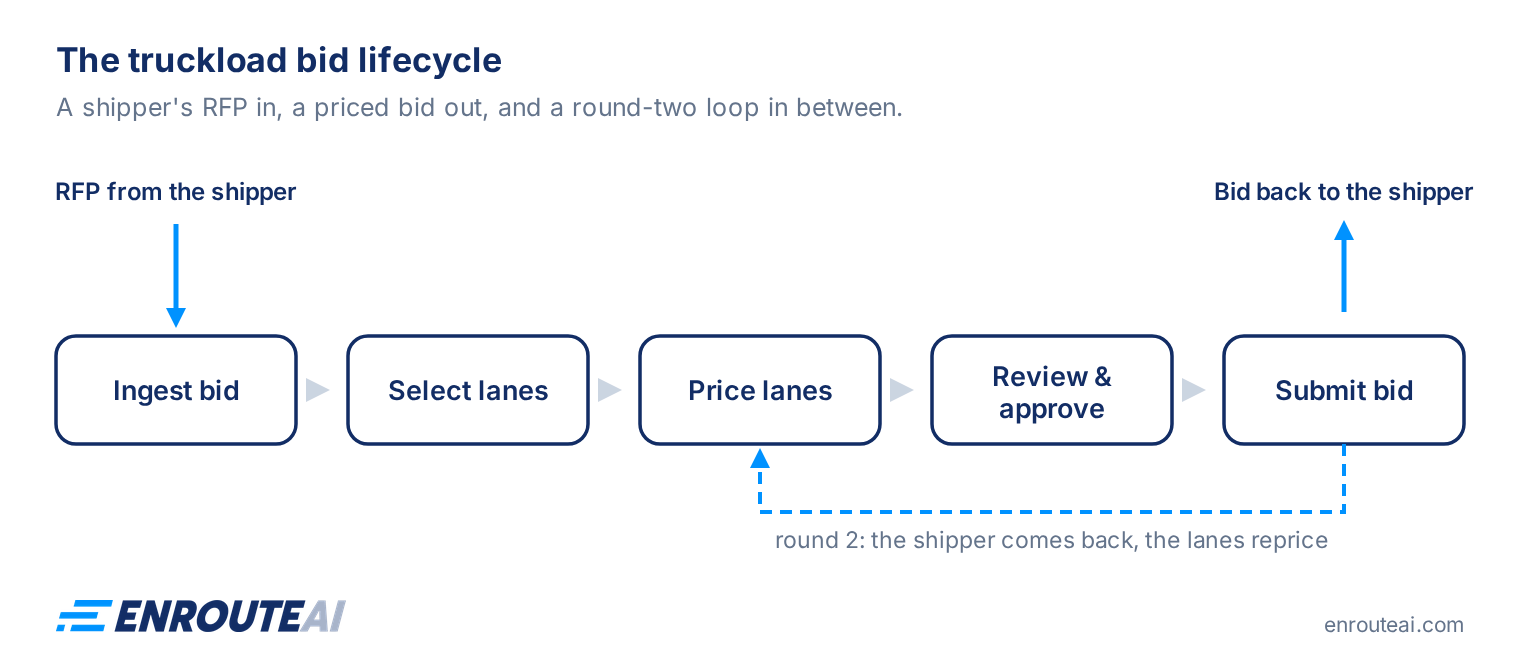
Import, in the shipper's format. There is no EnrouteAI template. The file loads as the shipper built it: any column layout, ZIPs or cities or 3-digit regions, one tab or ten. Recurring shippers get an import recipe, so next quarter's mini-bid loads the way last quarter's did.
Validation before pricing. ZIP codes and city names are checked, lane geography is verified, and the shipper's mileage is compared against industry truck routing so mileage disagreements surface on day one instead of in the margin.
Pricing from your side of the table. Rates build from the carrier's own inputs: rate strategy by customer, cargo, and drop versus live; cost floor; and the record of what was quoted, won, and actually ran. Beside each rate sits a fuel-normalized market band, there to challenge the number, not to be the number.
Fuel, per bid. Each bid carries its own fuel program: per-mile DOE table, percent of linehaul, or fixed. The linehaul math follows the program (subtract for tables, divide for percentages), which is exactly the arithmetic we published in the fuel surcharge manual.
Network fit, at file scale. Lanes are flagged for how they sit in the carrier's network: backhaul opportunities, triangle pairings, deadhead exposure. Reading that off a map works at 40 lanes; the flags are what make it work at 10,000.
Export, round trip. The finished bid writes back into the shipper's own sheet: same columns, same lane IDs, declined lanes left clean. What the shipper receives is their file, answered.
Bid memory. Everything submitted is kept: rates, fuel basis, win outcomes, notes. At renewal, this year's ask lands next to what was actually submitted last year, fuel-normalized so the comparison holds up. Memory is empty on day one and compounding by the second bid; it is the part of the product that gets more valuable every quarter.
What EnrouteAI is not
- Not a load board or a benchmark. It sits beside DAT or SONAR and uses market data as a check. It does not sell you the market rate as your rate.
- Not a TMS. It ends where the submitted bid begins; dispatch, tracking, and billing live elsewhere.
- Not questionnaire software. The prose sections of an RFP (security forms, service questionnaires) are a different job for a different tool. EnrouteAI prices the lane file, which is where a truckload bid is won.
- Not a broker or a marketplace. EnrouteAI never touches the freight and is not on the other side of your rates. It is software on the carrier's side of the table, and the carrier's numbers stay the carrier's.
Where it came from
Enroute started in delivery routing: route optimization for final-mile fleets, which is where the company's coverage in the freight press comes from. The carrier product is built on that routing foundation, pointed at a different pain: not "which turn does the van take" but "what do we quote on 1,800 lanes by Friday."
Getting started
There is no implementation project. The first step is a working session on a live bid: bring the RFP that is open on your desk, and price it in the product on the call. The bar to judge us on is the one this category is actually judged on: one bid through, end to end. File in, lanes priced, file out, submitted. That is also the fastest way to find out if it is not for you. Book that here.
FAQ
Does EnrouteAI work with my shipper's file format?
Yes; reading the file as it arrived is the point. Bids from shipper platforms such as Emerge or Jaggaer, and bids that arrive as plain Excel on email, load the same way.
Is EnrouteAI a freight broker?
No. It moves no freight, holds no capacity, and takes no side of a transaction. It is pricing software used by the carrier.
Does it replace DAT or SONAR?
No, it uses them. A benchmark subscription is an input; EnrouteAI puts that market band beside a rate built from your own economics.
What history does a carrier need on day one?
None. A rate strategy as simple as a state-based rate card is enough to price the first bid; bid memory builds itself from there.
How is EnrouteAI priced?
Flat monthly subscription. Specifics on the call, because they depend on fleet and bid volume.