
3 more RFPs just landed.
All from your best customers.
All due this Friday.
You know how this week goes: your two analysts already underwater, every request "urgent," days vanishing into formatting grunt work no shipper pays for. And all the while you're trying to keep the account on your phone happy.
RFP pricing software for truckload carriers. Upload each file exactly as it arrived. Every lane you bid, priced by your pricing strategy and backed by your real numbers, with the market band beside it and network fit flagged, then exported back in the shipper's format. Hours per bid, not days.
30 minutes. Your file, your lanes, priced on the call.
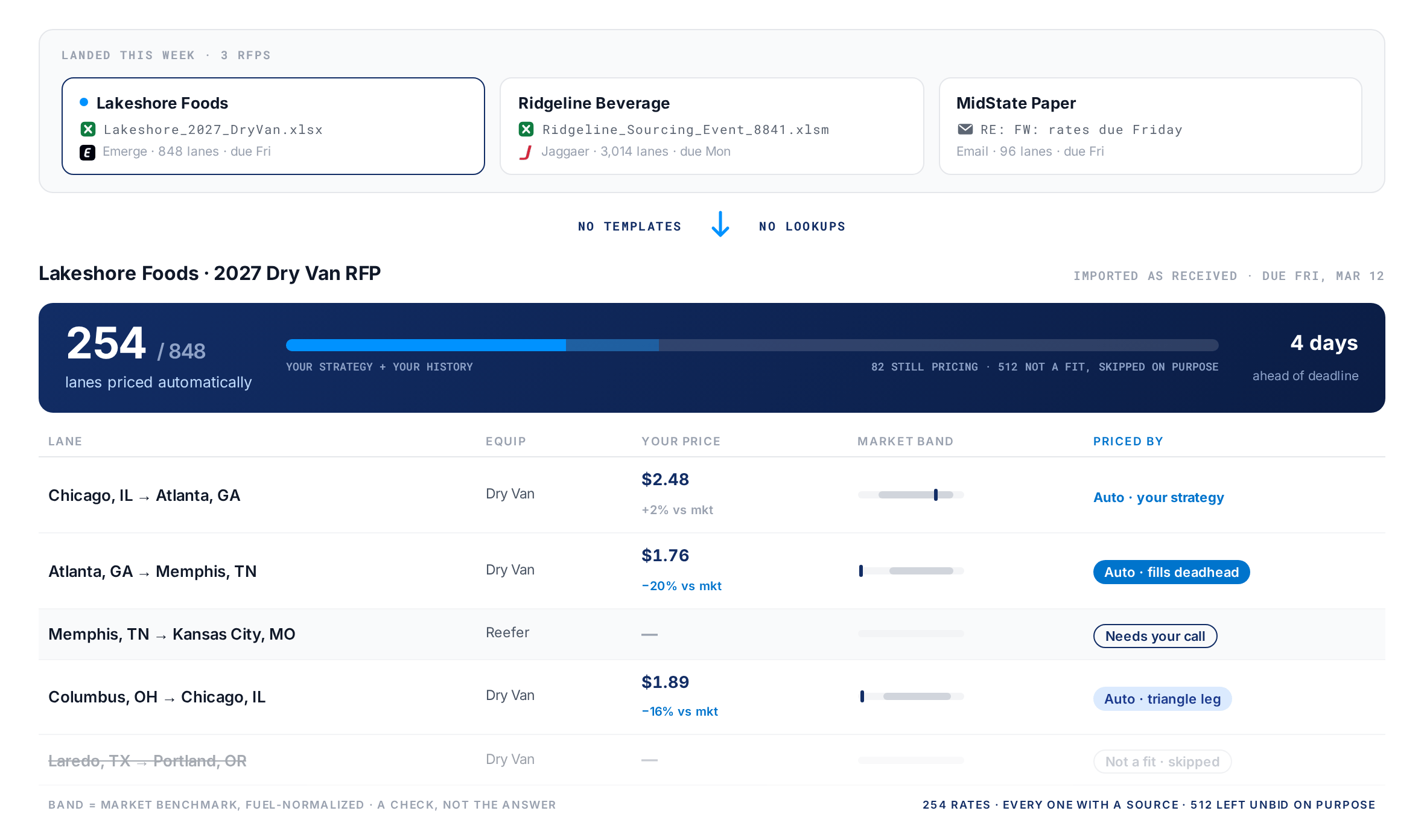
Answer every RFP on your desk, by its deadline
EnrouteAI is RFP pricing software for truckload carrier sales and pricing teams: every lane you bid, priced with confidence, without the week of spreadsheet cleanup, the benchmark scavenger hunt, or guessing which lanes fit your network. Here's your week with it:
Forwarding each file to your analysts and waiting days for a cleaned-up template.
Upload it as-is. Spreadsheets from Emerge and Jaggaer, or lanes in a forwarded email, all read as received.
Rating lanes off a market board that's never met your customer.
Every lane you bid, priced by your own pricing strategy, using your real numbers and your fuel programs, with the market band beside it on one screen.
Discovering the broken VLOOKUP after the bid went out, a mistake you eat for the full contract year.
Validation catches it before pricing starts. ZIPs, geo pairs, and shipper mileage all get checked on import.
Padding what you couldn't check, losing winnable lanes and winning the wrong ones.
Bid the lanes that fit your network, a source behind every rate, days early. And skip the rest on purpose.
The bids get done without you personally pushing every file through, and bid week stops eating the customer time that actually retains freight. Everything you bid is remembered.
Inbox to submitted, three moves
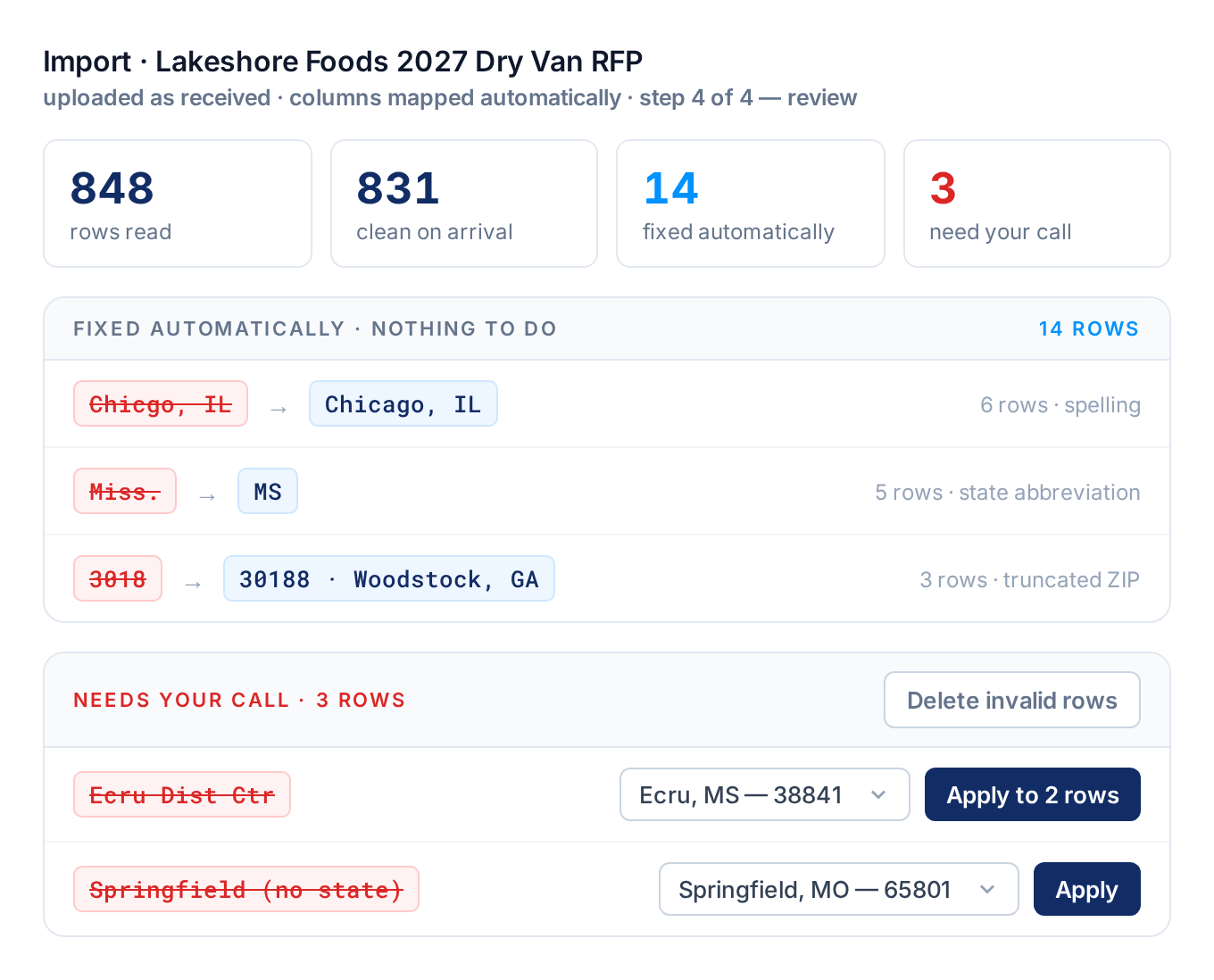
Upload it as it came
Spreadsheets from Emerge, Jaggaer, Keelvar, Coupa, or lanes in an email that is forwarded four times. No template, no reformatting. Files past 10,000 lanes open instantly; finding the 150 that fit your network is a filter, not a weekend.
Validation runs on import: ZIPs that don't match their cities, invalid geo pairs, shipper mileage that disagrees with PC*Miler. Fix a thousand lanes at once, not cell by cell.
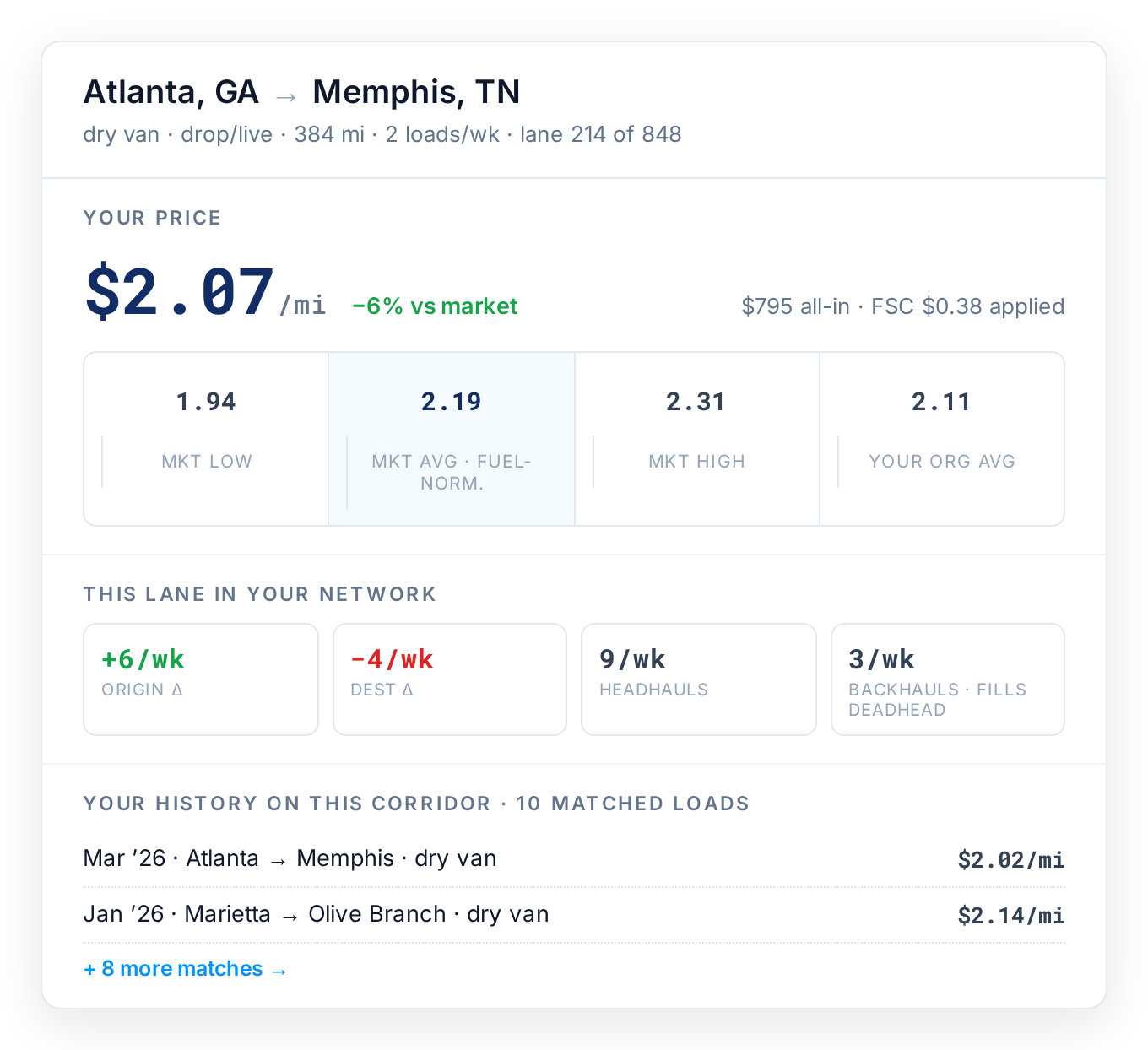
Price from one screen
Your strategy sets the rate: per customer, per cargo type, drop vs. live. Behind it sits what you actually bid, won, and ran. The DAT / SONAR band rides beside every rate as a fuel-normalized sanity check, not the answer.
Your network sits on top of the bid: backhauls, triangles, and lanes that fill deadhead miles get flagged automatically and priced to win, on purpose.
Export in their format
The shipper gets their own template back, filled. No reformatting on the way out. Your team keeps the opposite: every bid normalized into one standard view, whoever it arrived from.
A source behind every rate you submit, and the lanes that aren't your freight left unbid on purpose. Days ahead of the deadline.
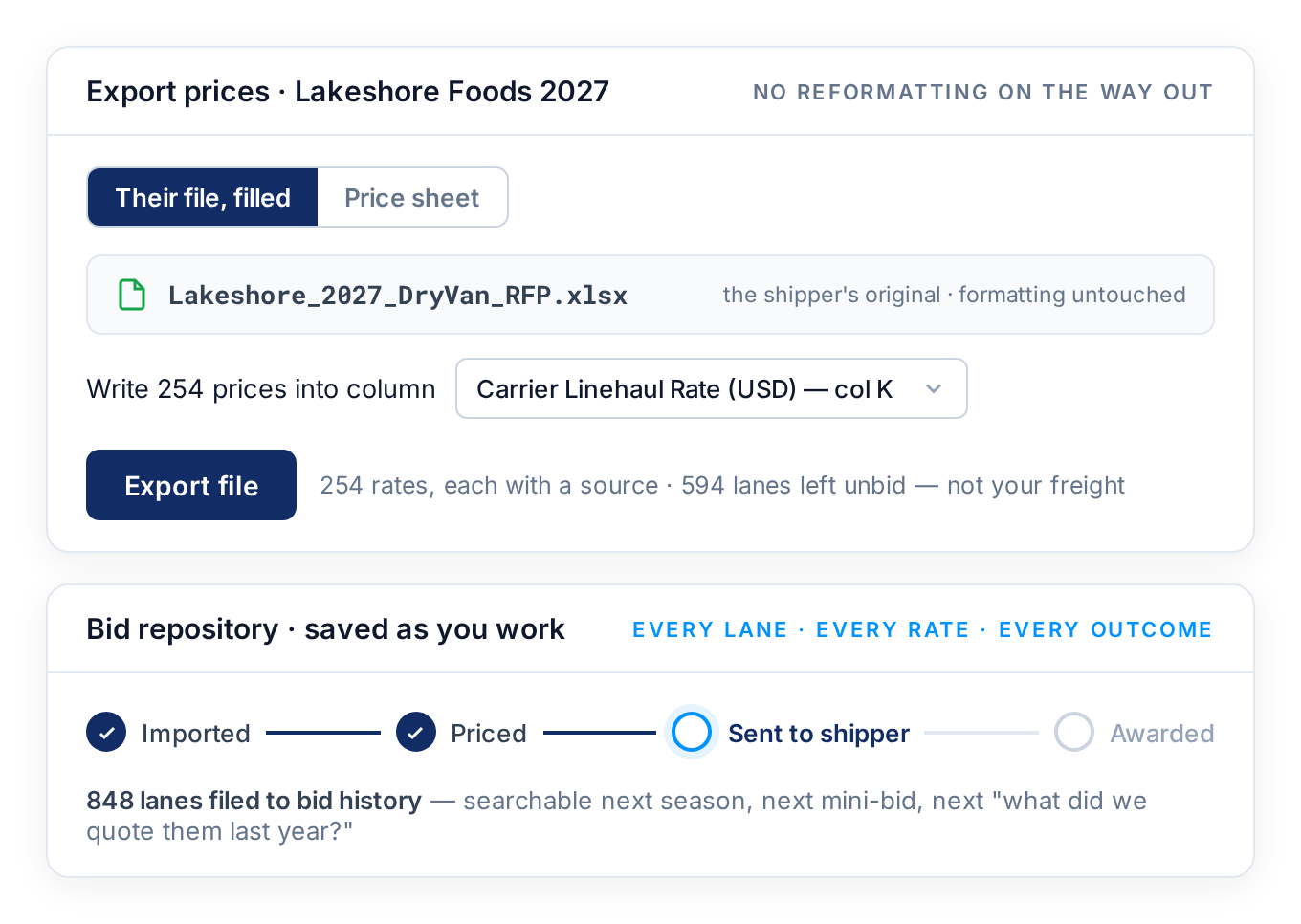
Every bid your team has ever made, remembered
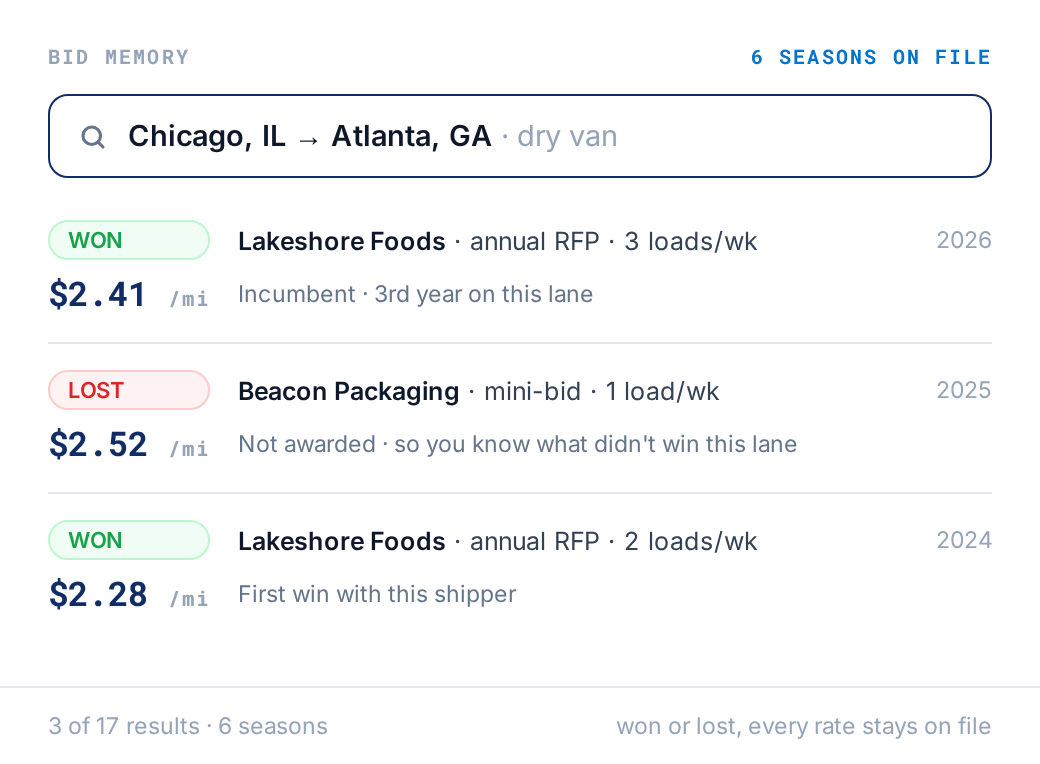
Right now, your pricing history lives in the TMS, a shared drive, and a dozen reps' laptops. When someone asks "What did we bid on Chicago–Atlanta last year?", the honest answer is a shrug.
Every lane priced in EnrouteAI lands in one searchable repository on its own, whether you won it, lost it, or walked away. Your second bid season is easier than your first. Your tenth starts with nine seasons of answers already written.
Bid season is the loud part.
The rest of the year is the
long part.
The same engine answers every pricing question that lands between seasons.
The questions you're already asking
"Every shipper's file is different. Ours are a mess."
That's the point of format-agnostic import. City/state, ZIP3, ZIP5, market names, custom zone matrices: files are read as received, and import recipes remember each shipper's quirks. The second file from the same shipper is instant.
"We already pay for DAT and SONAR."
Keep them. Rates come from your own strategy and your own numbers: what your trucks ran and what you got paid. The boards sit beside your rate as a fuel-normalized sanity check. They're averages of everyone else's freight; they don't know your customer, your reefer nuance, or whether the load is drop or live. You do.
"Our rates aren't comparable. Every customer has a different fuel program."
Per-mile, fixed, and breakthrough programs are handled, and historical rates are normalized for fuel, so a 2024 win and today's DAT band read in the same units.
"Years of our history is locked in spreadsheets and the TMS."
Bring it. Footprint matching runs against your historical loads and past bids, including lanes you've won that haven't started shipping yet.
"We have a bid due Friday. How long does setup take?"
There's no template to build and no data-mapping project in the way. The first thing you do in EnrouteAI is upload the bid you're working on. That's also how the first call works.
Already pricing real bid seasons
Written from real bids
The math and the workflow we run on real bids, written down.
Truckload RFP: The Carrier's Guide (2026)
A shipper's RFP decides a year of your contract freight in about three weeks. Here is how the bid actually runs, question by question, from the side of the table that has to price it.
Carrier Bidding Software: Which Side of the Bid Are You On? (2026)
Three different products share the phrase carrier bidding software, and two of them are built for the other side of the table. This is the taxonomy: what shipper bid platforms, carrier-side RFP pricing software, and TMS bid modules each actually do, a ten-second verb test for telling them apart on any product page, and the signs you are reading about software whose success metric is your revenue.
Apples to Apples: Comparing Freight Rates When Fuel Will Not Sit Still
Two comparisons decide most pricing conversations: what you quoted this shipper last year against what you are quoting now, and what you quote one shipper against what you quote another. Neither is apples to apples until fuel comes out of it. Between the last bid season and this one diesel moved $1.91 a gallon, and every schedule read it differently.
Skip the software evaluation.
Bring Friday's bid.
30 minutes, your file loaded live. You'll watch your lanes priced against your history, the market band, and your network fit, all before the call ends.
Price a live bid with us Not mid-bid right now? Remember us the day the next file lands.