
BLOG ·
How Much Fuel Does a Reefer Unit Burn? 0.8 to 1.5 Gallons an Hour, and Why a Dry Van Schedule Shortchanges You
A reefer unit burns roughly 0.8 gallons of diesel an hour at fresh setpoints and about 1.5 gallons an hour frozen. Fuel surcharge tables are built on a different number: tractor miles per gallon. A reefer unit does not care about your miles. It burns by the hour, by the setpoint, and by how long the doors are open, which is why the same schedule that nearly keeps a dry van whole leaves a frozen load 31 cents a mile short. Here is the full cost model and what to ask for at bid time.
Two trucks leave the same shipper on the same 700 mile lane on the same day, under the same fuel surcharge schedule. One is a dry van. One is a reefer at minus 10°F (minus 23°C). The schedule pays them both $0.65 a mile for fuel. The dry van burned $0.76 of diesel a mile. The reefer burned $0.96.
The dry van is 11 cents short. The reefer is 31 cents short, and nothing in the schedule mentions it, because almost every fuel surcharge table in truckload is built on one assumption: that the only engine burning diesel is the one pulling the truck.
The short version. A refrigerated trailer burns about 15 percent more fuel per mile than a dry van on fresh produce and about 26 percent more on frozen. At the August 24, 2026 diesel price that is $0.11 a mile on fresh and $0.19 on frozen that no tractor-mpg schedule pays. On one 700 mile lane at three loads a week, that is $25,200 a year of unpaid fuel on fresh and $34,100 on frozen. The rest of this post is where those numbers come from, and the four ways to get them into a schedule.
This is the reefer half of our fuel surcharge manual. What a refrigeration unit actually burns, why frozen costs more than fresh, what that adds up to per mile at today's diesel price, and what to ask for at bid time.
The second engine
A trailer refrigeration unit (TRU) is its own diesel engine, typically a 2.2 liter, 33 to 35 horsepower unit under the nose of the trailer, with its own 50 gallon tank. Thermo King's Precedent and Carrier's X4 platforms both sit in that range.
The important part is not the size. It is what drives the burn:
- Time, not distance. The unit runs while you are loading, while you are at a receiver, while you sleep at a truck stop with a loaded trailer, and while you sit in traffic. Miles have nothing to do with it.
- Setpoint. Pulling a box down to minus 10°F (minus 23°C) takes far more work than holding it at 34°F (1°C).
- Ambient. The burn tracks the difference between outside air and setpoint. A 90°F (32°C) Texas afternoon costs more than a 50°F (10°C) morning.
- Door openings. Every stop dumps the cold air and forces a re-pull.
A per-mile fuel surcharge table cannot see any of those four things. That is the whole problem in one sentence.
What a reefer unit actually burns
Measured, from a bench test: the National Renewable Energy Laboratory ran a Thermo King SB-200 at the California Air Resources Board's Stockton lab and recorded roughly 1.28 to 1.35 gallons an hour at high engine speed (the speed the unit selects under heavy cooling demand) and 0.53 to 0.73 gallons an hour at low speed (NREL/CP-540-46598, SAE 2009-01-2722).
From fleets: Transport Topics quotes Trailer Equipment Northwest putting single-temp units at about 0.8 gallons per runtime hour and multi-temp at about 0.9, with single-temp trailers logging around 2,500 runtime hours a year (about 2,000 gallons) and multi-temp 3,500 to 4,000 hours (about 3,150 gallons).
Put together, with the setpoint split that trade guides consistently report:
| Setpoint and mode | Burn, gallons per runtime hour |
|---|---|
| Fresh, 34 to 38°F (1 to 3°C), start-stop (cycle) mode | 0.5 to 0.8 |
| Fresh, 34 to 38°F (1 to 3°C), continuous | 0.8 to 1.0 |
| Frozen, minus 10 to minus 20°F (minus 23 to minus 29°C), continuous | 1.0 to 1.5 |
| Older units (pre-2010 vintage) | 1.5 and up |
Two details that matter at bid time. First, frozen loads and most protein are run in continuous mode as standard practice, so they also lose the 15 to 25 percent saving that start-stop gives fresh produce. The setpoint penalty and the mode penalty stack. Second, pre-cooling an empty trailer takes 1 to 3 hours and roughly 1 to 2 gallons before the load is even on.
The cost model
The formula. The first term is what every fuel surcharge table already pays for. The second term is the one no tractor-mpg table has ever seen.
fuel cost per mile = P / MPG + (TRU gallons per hour x R / S) x P
P = diesel price per gallon
MPG = tractor fuel economy
R = TRU runtime hours per driving hour
S = average line haul speed, miles per hour
Assumptions, each one labeled so you can argue with it:
| Input | Value | Where it comes from |
|---|---|---|
| P, diesel | $5.652 | EIA U.S. on-highway average, August 24, 2026 print |
| MPG, dry van | 7.4 | ATRI 2025 operational costs, fleet average 7.43 |
| MPG, reefer tractor | 7.3 | Reefer trailer plus unit plus fuel runs 2,000 to 3,000 lb heavier; NACFE puts the weight effect at 0.5 to 0.6 percent per 1,000 lb, so about 1.5 percent |
| S, average speed | 45 mph | Between the 50 to 60 mph interstate range (DOE) and the low 40s all-operations average |
| R, runtime per driving hour | 1.3 | The unit runs through loading, unloading, and breaks. Consistent with 2,500 runtime hours a year on a trailer running roughly 2,000 driving hours |
| TRU burn, fresh | 0.65 gal/hr | Midpoint of the 0.5 to 0.8 range above |
| TRU burn, frozen | 1.15 gal/hr | Midpoint of 1.0 to 1.3, and the NREL high-speed measurement is 1.3 |
Run it at today's diesel:
| Tractor $/mi | TRU adder $/mi | Total fuel $/mi | Vs dry van | |
|---|---|---|---|---|
| Dry van | 0.764 | 0.000 | 0.764 | baseline |
| Fresh reefer, 34 to 38°F (1 to 3°C) | 0.774 | 0.106 | 0.880 | +15% |
| Frozen reefer, minus 10°F (minus 23°C) | 0.774 | 0.188 | 0.962 | +26% |
In gallons, which is the version that stays true when diesel moves: a dry van burns 0.135 gallons a mile, a fresh reefer 0.156, a frozen reefer 0.170. The TRU itself is 0.019 gallons a mile fresh and 0.033 frozen. Multiply either by the DOE price and you have the adder at any diesel price, which is exactly the form you want when you ask a shipper for one.
The honest range, flexing the two softest assumptions (runtime 1.0 to 1.5 hours per driving hour, speed 42 to 50 mph) and the burn rates across their published spreads, at today's $5.652:
- Fresh: $0.06 to $0.16 a mile
- Frozen: $0.11 to $0.30 a mile
Multi-stop food service work sits at the top of those ranges. Drop and hook line haul sits at the bottom. Two independent checks: O Trucking's 2026 guide recommends a reefer premium of $0.08 to $0.15 a mile over standard surcharge at lower diesel prices, and industry glossaries put reefer surcharges at 10 to 20 percent or more above standard. Our adder is 14 to 25 percent of the dry van fuel cost. Everyone lands in the same place.
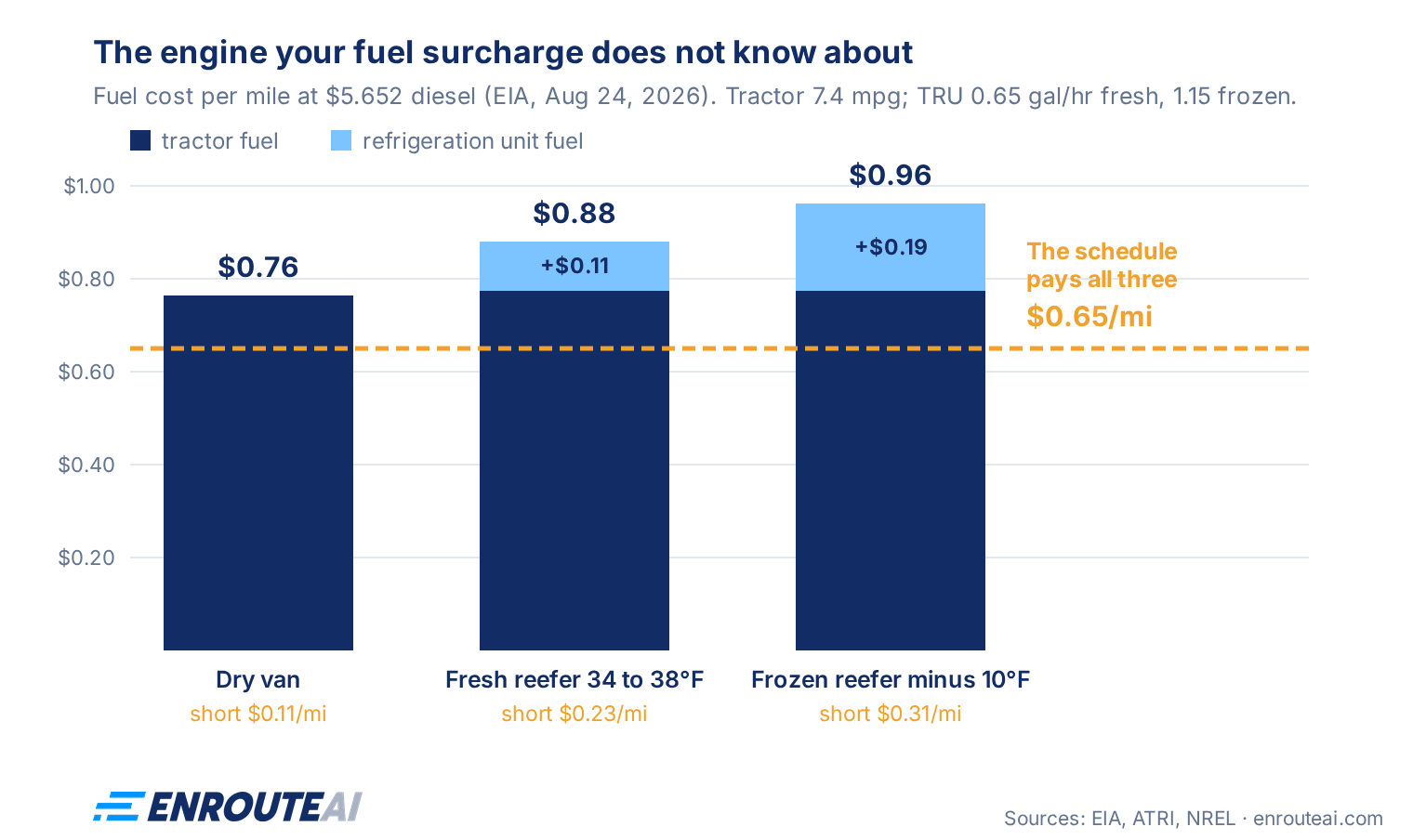
The same lane, three ways
Take the lane from the manual: 700 miles, three loads a week, a shipper on a monthly-clock bracket table. In July 2026 the DOE monthly average was $4.955, so the table pays $0.65 a mile, or $455 a load, to every truck in the program.
| Equipment | Fuel cost $/mi | Schedule pays | Gap $/mi | Gap per load | Gap per year (156 loads) |
|---|---|---|---|---|---|
| Dry van | 0.764 | 0.650 | -0.114 | -$80 | -$12,400 |
| Fresh reefer | 0.880 | 0.650 | -0.230 | -$161 | -$25,200 |
| Frozen reefer | 0.962 | 0.650 | -0.312 | -$218 | -$34,100 |
Read the last column again. The frozen truck is short nearly three times what the dry van is short, on the same schedule, on the same lane, and the difference between them, $0.20 a mile or about $21,600 a year on one lane, is the piece that is invisible unless someone runs this arithmetic before the bid goes in.
One carrier's receipts, for scale
A refrigerated carrier shared their 2025 fuel surcharge receipts with us. Across that year, when the national diesel average ran $3.66, their frozen freight paid about $0.60 a mile of surcharge and their fresh temperature-controlled freight about $0.45, while dry van schedules at the same diesel prices were paying $0.55 to $0.70.
Run the model above at $3.66 diesel and the picture is unambiguous. Frozen fuel cost $0.62 a mile, so the $0.60 schedule covered fuel almost exactly and left nothing behind for the unit's extra wear. Fresh cost $0.57 a mile, and the $0.45 schedule did not even cover the tractor's own fuel, which was $0.50 at 7.3 mpg before the refrigeration unit burned a drop. The truck earning the lower surcharge was the truck burning 15 percent more fuel than a dry van.
That is one carrier and one year, so treat it as a data point rather than a benchmark. It is worth reproducing on your own settlements: take a year of surcharge receipts by equipment type, run this model at the diesel prices that applied, and see which side of the line each program sits on.
Nothing here says the shipper is cheating. The schedule was written for tractors, it does what it says, and it is usually not negotiable. Which leaves two moves: ask for a reefer program, or price the gap into the linehaul. Do both.
Four ways to write a reefer premium into a schedule
If the shipper will open the fuel program, these are the four shapes you will see in the market, in rising order of how well they track reality. All four are calibrated below to the same frozen load on the same monthly-clock table, so you can see they are the same money wearing different clothes.
1. A percent uplift on the standard surcharge. Reefer pays the dry van table plus a fixed percentage. To cover the frozen adder ($0.165 a mile at the July average of $4.955), the uplift is 25 percent; fresh needs 14 percent. Simple, and it is what most shippers who do anything at all already do. Weakness: the percentage is applied to a table that already assumes the wrong mpg, so two errors compound.
2. A lower mpg divisor for refrigerated equipment. Bracket tables are the old formula frozen into rows: (DOE price minus peg) divided by an assumed mpg. This table's implied peg is about $1.05 at 6.0 mpg. Rebuild the same table for reefer at 4.8 mpg and it pays the frozen number; 5.25 mpg pays fresh. Elegant, because it keeps one table shape and one clock, and shippers who already think in mpg terms accept it easily.
3. A flat cents-per-mile TRU adder. Add $0.19 a mile for frozen, $0.11 for fresh, on top of the standard table. Easy to administer, and wrong within a month, because it does not float with diesel while everything else in the schedule does. Diesel moved 20 cents a gallon in the week this post was written.
4. A gallons-per-mile TRU adder indexed to the same DOE price. Add 0.033 gallons a mile for frozen, 0.019 for fresh, multiplied by the same DOE average the table already reads. At $4.955 that is $0.16 and $0.09. At $5.652 it is $0.19 and $0.11. It floats correctly, it uses an index the shipper already trusts, it needs no new data feed, and it is defensible from published burn rates. This is the ask.
If you run multi-stop or long dwell work, the honest version of the ask is a runtime-hours surcharge (gallons per hour times DOE price times measured runtime hours) because that is what the physics actually says. Telematics on modern units reports runtime hours. Very few shippers will administer it. Ask anyway, and settle for number 4 with a runtime assumption written into the contract.
When the shipper will not move: price the gap
Most of the time the answer is no, one program for everyone. That is fine, as long as the gap ends up in the linehaul instead of in your margin. The keep-whole equation from the manual, with the reefer term in it:
submit linehaul = target all-in − shipper's FSC
where target all-in = operating target + your real fuel cost, TRU included
For the frozen load on the lane above: a $3.00 operating target plus $0.962 of real fuel is $3.962 all-in. The schedule pays $0.65, so you submit $3.31 a mile, not the $3.11 a dry van bidder on the same lane submits. You will look 6 percent more expensive than the dry van carrier in the shipper's grid. You are not more expensive; you are hauling a load that burns 26 percent more fuel, and you are the only one who priced it.
The corollary is the one that decides whether a refrigerated fleet makes money in a soft market: if you win frozen freight at dry van linehaul under a dry van schedule, you did not win it. Every load carries the TRU adder as a subsidy to the shipper, all year.
What to check before you bid refrigerated freight
- Does the fuel program mention refrigerated equipment at all? If the words reefer, refrigerated, or TRU do not appear, the answer is no, and the number is 11 cents a mile on fresh and 19 on frozen at today's diesel, more if the trailer sits.
- Setpoint mix. Frozen and fresh are different bids. If the RFP mixes them under one rate, price to the mix, or bid them separately and say why.
- Dwell and stops. Runtime hours per driving hour is the input that moves the adder the most. Multi-stop distribution work can double it. Ask for the scheduled dwell in the RFP, or price it from your own history on that shipper.
- Continuous mode requirements. Protein and frozen run continuous by contract and by physics. That removes the start-stop saving, and it belongs in the number.
- Pre-cool. Who pays for the 1 to 2 gallons before loading? On short lanes that is another cent or two a mile.
- Fuel taxes. TRU fuel is bought and taxed differently in many states. Whatever your treatment, be consistent between the cost model and the invoice.
- Your own burn. Modern units claim double-digit percentage improvements over the generation the public numbers were measured on. If your telematics gives you real runtime hours and gallons, use yours; this model is what to use when it does not.
The closing note
The arithmetic on one frozen lane takes ten minutes: burn rate, runtime, speed, diesel, subtract what the table pays. The problem is that a refrigerated RFP is 300 lanes across four setpoints and two schedules, due Friday, and the ten minutes turns into a week nobody has. That is the version EnrouteAI is built for: every lane priced from your own cost basis and the bid's actual fuel program, with the surcharge gap shown before you submit instead of discovered in month seven. If your refrigerated freight has been quietly funding somebody's cold chain, that is worth a look.
A tool for this, in preview
We are building a fuel surcharge simulator that runs this arithmetic against your own schedule: enter the bracket table, your fuel economy, and your setpoint mix, and see what the program pays against what you actually burn as diesel moves. It is in internal preview right now. If you want early access, ask for it here.
Sources
- EIA, weekly U.S. on-highway diesel prices
- NREL / CARB, Emissions of Transport Refrigeration Units (NREL/CP-540-46598, SAE 2009-01-2722), the bench measurement of TRU fuel consumption
- ATRI, Operational Costs of Trucking, fleet average fuel economy
- Transport Topics, How Should Reefer Fleets Tackle the Diesel Double Whammy?, fleet runtime hours and surcharge practice
- NACFE, lightweighting research, the weight-to-fuel sensitivity behind the 7.3 mpg reefer tractor figure
- CARB, Transport Refrigeration Unit regulation
FAQ
Why is my reefer fuel surcharge too low?
Because the schedule was almost certainly built on tractor fuel economy alone. Fuel surcharge tables compute (DOE diesel price minus a peg) divided by an assumed miles per gallon, usually around 6. A refrigeration unit is a second diesel engine that burns by the hour, so no per-mile formula keyed to tractor mpg can pay for it. At the August 24, 2026 diesel price the missing piece is about $0.11 a mile on fresh and $0.19 on frozen.
How much fuel does a reefer unit burn per hour?
Modern single-temp units run roughly 0.5 to 0.8 gallons an hour at fresh setpoints, 34 to 38°F (1 to 3°C), in start-stop mode, and 1.0 to 1.5 gallons an hour at frozen setpoints, minus 10 to minus 20°F (minus 23 to minus 29°C), in continuous mode. Bench measurement on a Thermo King SB-200 by NREL recorded 0.53 to 0.73 gallons an hour at low engine speed and 1.28 to 1.35 at high speed. Fleet figures from Transport Topics put single-temp units near 0.8 gallons an hour averaged across a year.
How much more fuel does a reefer use than a dry van?
About 15 percent more total fuel per mile at fresh setpoints and about 26 percent more at frozen, once you add the refrigeration unit's burn to the slightly worse tractor economy from the heavier trailer. In gallons per mile: 0.135 dry van, 0.156 fresh, 0.170 frozen.
What is a reasonable reefer fuel surcharge premium?
Published market practice is 10 to 20 percent or more over the standard surcharge, and independent guides recommend $0.08 to $0.15 a mile. Our cost model puts the true adder at 14 percent of dry van fuel cost for fresh and 25 percent for frozen, which is $0.11 and $0.19 a mile at $5.652 diesel. The most durable form is a gallons-per-mile adder (0.019 fresh, 0.033 frozen) multiplied by the same DOE index the main table uses.
Does frozen freight really cost more to haul than fresh?
On fuel, yes, and for two stacking reasons: the unit burns 1.3 to 2 times as much per runtime hour at minus 10°F (minus 23°C) as it does at 34°F (1°C), and frozen loads run in continuous mode, which forfeits the 15 to 25 percent saving that start-stop mode gives hardy fresh produce. The pure fuel difference is roughly $0.08 a mile at mid assumptions and stretches past $0.14 in hot ambients with long dwell.
Do fuel surcharges cover the reefer unit?
Usually not. One large refrigerated carrier told Transport Topics that fewer than a third of its customers paid any refrigeration unit surcharge. Unless the fuel program names refrigerated equipment, assume it pays tractor fuel only and put the difference in your linehaul.